June 24, 1999

By MATTHEW MIRAPAUL 
No Clicking Allowed in Artist's Browser
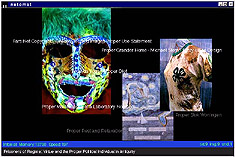
 photo of a fashion model drifts across the computer screen, followed by a Cezanne reproduction. Lines of text like "implicate beauty" and "what is art for?" glide over the images. Moving the cursor changes the direction of the flow, but there are no links to click or pages to load. Instead, new pictures and phrases appear that are loosely related to the others.
|
|
Netomat pulls images and text from the Web and sends them floating across the screen.
|
This is not surfing the Web, it is taking a dip in the Internet's stream of consciousness. The experience is made possible by Netomat, an artist-designed alternative to the standard Web browser. Scheduled for release on Thursday, the free progam will be available for download from the Netomat site. (Free Java software is also required to run it.)
Netomat's author is Maciej Wisniewski (pronounced MAH-chee VEESH-nyev-skee), a New York-based artist who works as a software developer for IBM. In a telephone interview, he explained that one of the reasons he wrote the software was to expose the powerful conventions imposed by the first Web browsers and still in use today.
For example, Netomat allows users to steer their browsing sessions by entering keywords at the bottom of the screen. But Wisniewski said that everyone who views the software in action immediately asks the same question: where do I click?
"The early browsers created behavioral patterns that define the way we think about the network," Wisniewski said. "Not much has changed since then. There's the click-back and the go-forward. These are the semantics that have been created by the software, but they have nothing to do with the network itself. What I'm trying to say is that there are many other ways of interfacing with the network."
Netomat is another indication that digital artists are increasingly focusing their energies on the technology underlying what is displayed on the computer screen. The medium, not the content, is sparking their creative endeavors.
"It's sort of like oil on canvas," said Mark Napier, another New York-based artist. "You can't ignore the canvas."
On Thursday, Napier plans to launch Riot, an online work that builds kinetic collages out of the three Web pages most recently submitted by visitors. Napier described the work as the "first multi-user browser." It is a successor to his page-destroying Shredder program.
Netomat and Riot are not the first artist-developed browser programs. That honor belongs to Web Stalker, released in 1997 by a British trio known as I/O/D. Next month, they are planning to release a chat-like communications program.
Artistic interest in browsers has even spawned an annual competition. International Browserday, sponsored by Amsterdam's Society for Old and New Media, invites students to design a new Internet interface. The 1999 winner was announced last month, but the entries cannot yet be viewed online.
Wisniewski said Netomat is meant to change the way users perceive the vast network of resources in cyberspace. "There's no going to a page," he said. "It's a constant stream of data. Netomat doesn't think of the network as a magazine, a radio station or a book. It cuts through the flow of information and gets a snapshot of the Internet from several different sources."
|
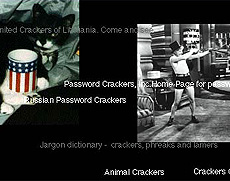
Detail of a Netomat mix.
|
|
"It learns from you. Every single line that you type that has successfully returned some result, it will memorize it."
Once Netomat is running, users can decide if they want to see text, images or a mix. The software will also retrieve audio files. Starting on Thursday, Netomat will be exhibited at the Postmasters Gallery in Manhattan, and Wisniewski will demonstrate it there in the coming weeks.
With its nearly full-screen layout, black background and constantly mobile graphics, Netomat provides an unusual, if not arresting, experience. As software, it seems more poetic than practical, but Wisniewski said Netomat may have commercial potential, perhaps as the engine for individually customized portals. He is also considering making parts of the underlying code available to other digital artists so they can contribute to the project's development.
A native of Poland, Wisniewski has created a number of Web-based works that employ online content to artistic effect. In Turnstile, lines of text culled at random from diverse sites scroll across the screen, their disconnectedness taking on its own meaning.
Wisniewski hopes Netomat will remind its users that the Internet is constructed by humans and is more than just a vast, impersonal database. With the links removed, viewers are forced to consider what -- and who -- the sources of information might be.
"I think sometimes of the network as the many people who contribute to it," he said. "All the information that this browser retrieves and displays in front of you is information that somebody has made the effort to create and put up on the network. The way we are accustomed to viewing them is very one dimensional."


